
Product Guides
Best Waterproof Backpacks for Outdoor Travel in 2026: Features, Materials & Buying Guide
Planning a hiking trip, weekend camping adventure, or outdoor getaway? One piece of equipment you should never overlook is your backpack.
Outdoor conditions can change quickly. A clear morning can turn into an afternoon of rain, and unexpected splashes or damp environments can put your belongings at risk. Whether you are carrying a camera, laptop, clothing, food, or everyday essentials, choosing a backpack with suitable water protection can make a significant difference.
But what actually makes a backpack waterproof? Is water-resistant fabric enough for outdoor travel? And how do you choose the right size, material, and construction for your activities?
In this guide, we break down the essential features, compare different levels of water protection, and explain what to look for before purchasing your next outdoor backpack.
Table of Contents
- Waterproof vs. Water-Resistant Backpacks: What’s the Difference?
- What Materials Are Best for Waterproof Backpacks?
- Which Waterproof Features Should You Look For?
- Comfort and Fit: What Matters for Outdoor Travel?
- Best Backpack Features for Different Outdoor Activities
- How to Protect Your Belongings During Heavy Rain
- Common Mistakes When Buying a Waterproof Backpack
- Waterproof Backpack Buying Checklist
- Frequently Asked Questions
1. Waterproof vs. Water-Resistant Backpacks: What’s the Difference?
Before choosing an outdoor backpack, it is important to understand the difference between waterproof and water-resistant construction.
These terms are often used interchangeably, but they do not mean the same thing.
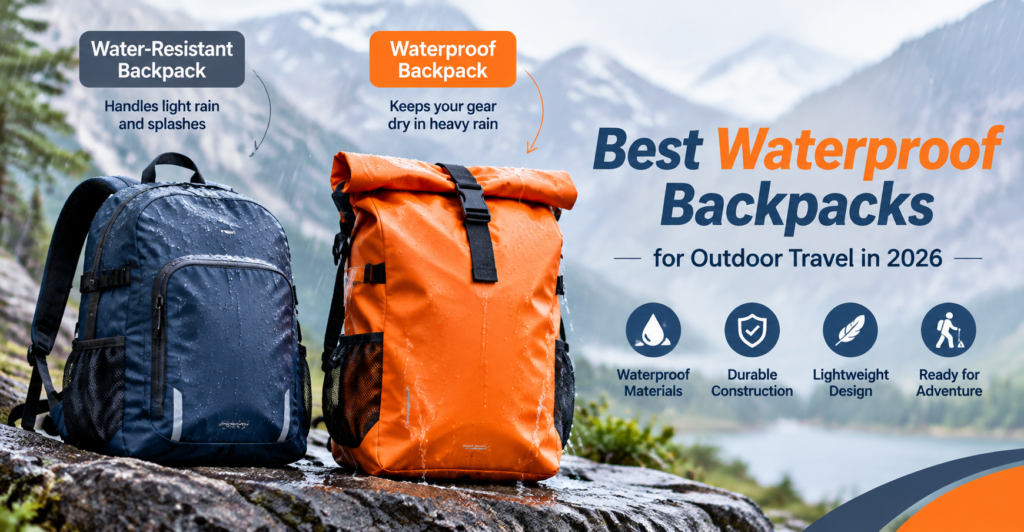
A water-resistant backpack is designed to handle limited exposure to moisture, such as light rain, splashes, or occasional contact with wet surfaces.
A waterproof backpack is designed to provide a stronger barrier against water entering the main compartment. Its actual protection depends on the materials, seams, closures, and tested performance of the complete product.
Waterproof vs. Water-Resistant Comparison
| Feature | Water-Resistant Backpack | Waterproof Backpack |
|---|---|---|
| Light rain | Generally suitable, depending on construction | Designed to provide protection |
| Water splashes | Offers some protection | Designed for stronger protection |
| Prolonged rain | Protection may be limited | Depends on product specifications |
| Sealed seams | Not always included | Common in specialized waterproof designs |
| Waterproof closures | Not always included | May include roll-top or waterproof zipper systems |
| Water immersion | Not suitable unless specifically rated | Only suitable when specifically tested and rated |
Important: A backpack made from water-resistant fabric is not automatically waterproof. Water can still enter through stitching, zipper openings, and other construction points.
For everyday commuting and occasional outdoor activities, a water-resistant backpack may be sufficient. For kayaking, extended exposure to heavy rain, or activities near water, a purpose-built waterproof bag with clearly documented protection may be more appropriate.
2. What Materials Are Best for Waterproof Backpacks?
The fabric is one of the first things to examine when comparing outdoor backpacks.
Different materials offer different combinations of durability, flexibility, weight, and moisture protection.
However, no material name alone guarantees waterproof performance. Fabric construction, coating, and manufacturing quality all matter.
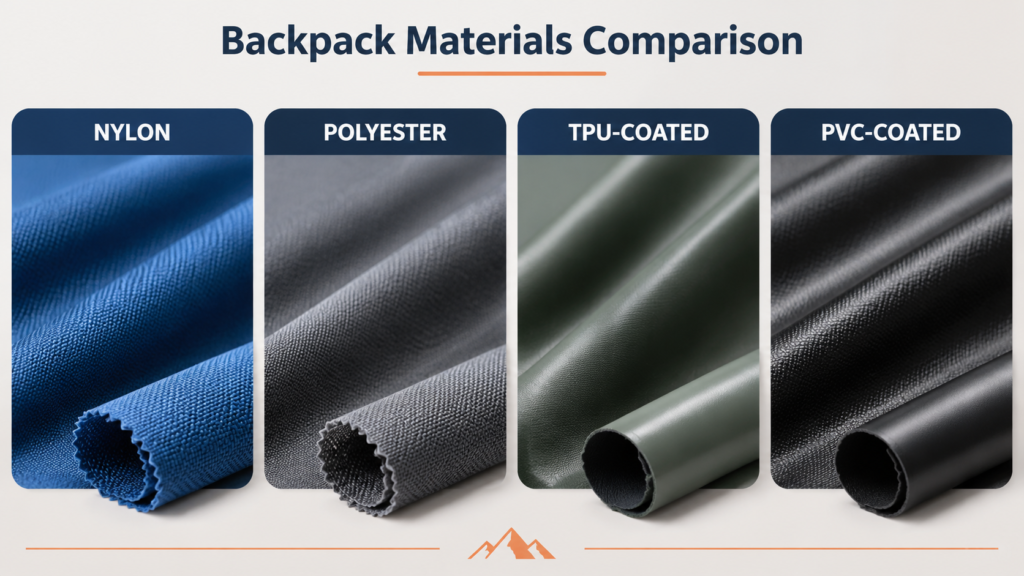
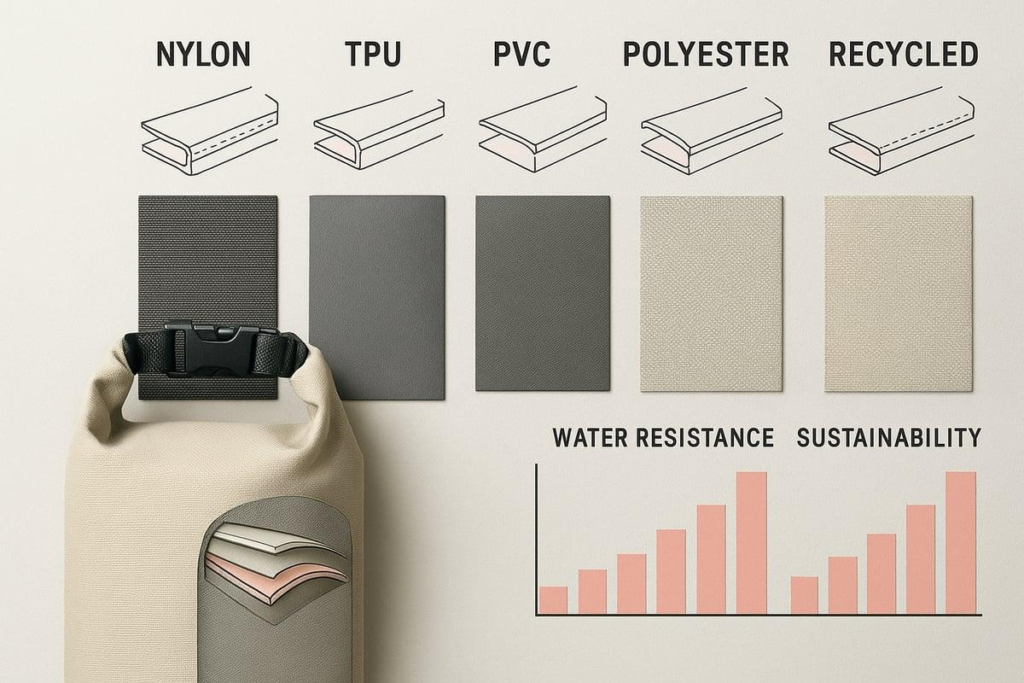
2.1 Nylon
Nylon is widely used in outdoor and travel backpacks because it offers a useful balance of strength, flexibility, and weight.
Some nylon fabrics feature additional coatings or treatments that improve their resistance to moisture.
Common applications include:
- Hiking backpacks.
- Tactical backpacks.
- Travel backpacks.
- Everyday outdoor bags.
When comparing nylon backpacks, check the fabric density, coating, and manufacturer’s water-resistance specifications.
2.2 Polyester
Polyester is another popular backpack material.
It is available in different fabric weights, textures, and finishes, making it suitable for many everyday and outdoor applications.
Advantages may include:
- A wide range of fabric constructions.
- Good dimensional stability.
- Versatile colors and finishes.
- Compatibility with water-resistant surface treatments.
Like nylon, polyester is not inherently waterproof in every construction.
2.3 TPU-Coated Fabrics
Thermoplastic polyurethane (TPU) coatings are used in some specialized waterproof bags.
They can create a water-resistant or waterproof barrier when combined with suitable fabric construction and manufacturing techniques.
TPU-coated materials are commonly found in dry bags and certain outdoor equipment bags.
2.4 PVC-Coated Fabrics
PVC-coated fabrics are also used in specialized waterproof products.
They can provide a substantial barrier against moisture, depending on the material and construction.
However, weight, flexibility, temperature performance, and long-term material characteristics should also be considered.
Material Comparison
| Material | Main Characteristics | Common Applications |
|---|---|---|
| Nylon | Flexible, lightweight options, versatile | Outdoor and everyday backpacks |
| Polyester | Versatile, available in different weights and finishes | Travel and daily-use backpacks |
| TPU-coated fabric | Can provide strong moisture protection | Waterproof travel and outdoor bags |
| PVC-coated fabric | Used in specialized waterproof constructions | Dry bags and equipment bags |
Which material should you choose?
For everyday outdoor travel, nylon and polyester backpacks with suitable water-resistant treatments can be practical choices.
For activities involving prolonged exposure to water, look for specialized waterproof construction rather than relying on the fabric name alone.
3.Which Waterproof Features Should You Look For?
Choosing a backpack based only on its outer material can lead to disappointment.
Water protection depends on the complete construction of the backpack.
Here are the most important details to examine.
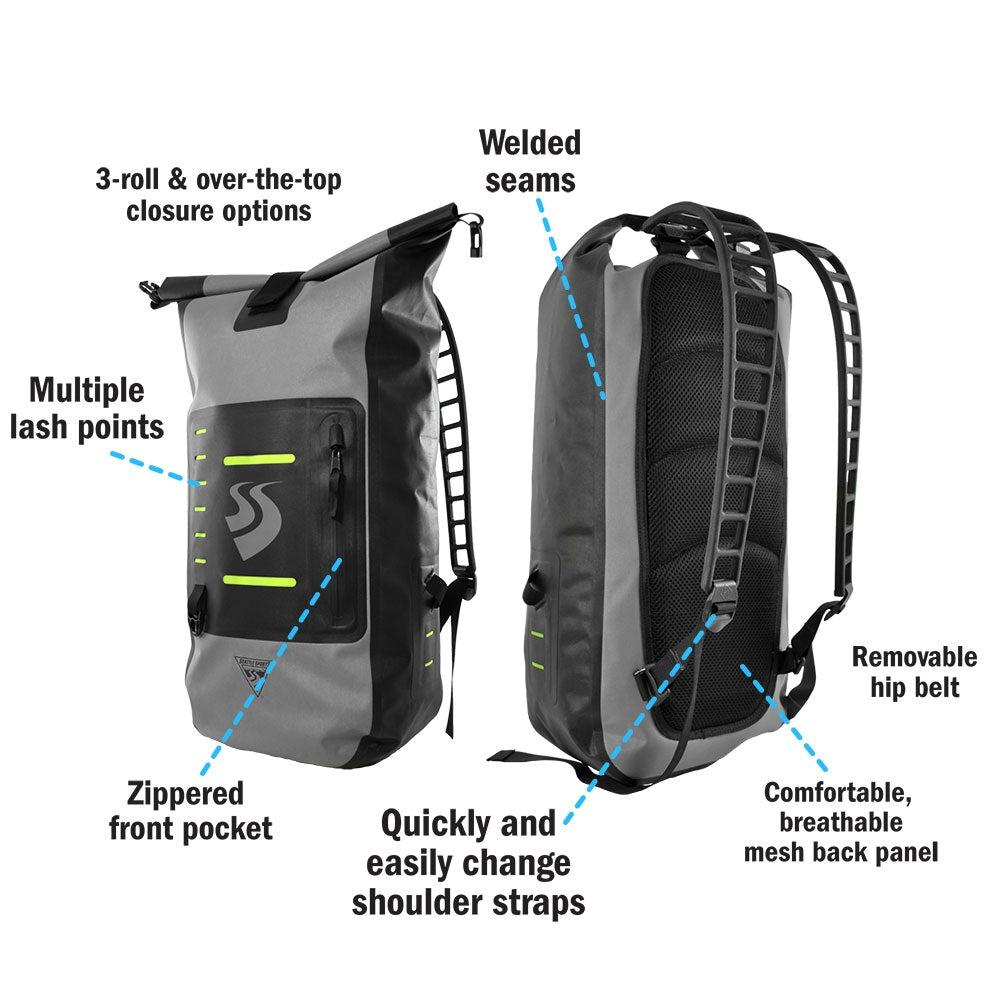
3.1 Waterproof or Water-Resistant Zippers
Zippers are potential entry points for moisture.
Some outdoor backpacks use specialized water-resistant zippers with protective coatings or additional sealing structures.
Others include zipper covers or storm flaps that help reduce direct exposure to rain.
When comparing backpacks, check:
- Whether the zipper is specifically designed for water resistance.
- Whether the zipper track has protective coverage.
- Whether the main compartment opening is exposed.
- Whether the manufacturer provides water-protection specifications.
A standard zipper should never be assumed to be waterproof.
3.2 Sealed or Taped Seams
Traditional stitched seams can create small openings where moisture may enter.
Specialized waterproof bags may use taped seams, welded seams, or other sealing techniques to reduce these potential entry points.
These construction methods are particularly important when the backpack is intended for extended exposure to water.
3.3 Roll-Top Closures
Roll-top closures are commonly found on waterproof outdoor bags.
The top opening is rolled down several times and secured with a buckle or similar fastening system.
This design can reduce direct water entry through the main opening when used correctly.
However, proper closure technique is essential, and protection depends on the complete bag construction.
3.4 Protective Bottom Construction
The bottom of a backpack often comes into contact with wet ground, rocks, and rough surfaces.
Look for:
- Reinforced bottom panels.
- Suitable fabric coatings.
- Durable stitching.
- Materials designed for the intended environment.
A stronger bottom construction can also help with everyday wear and abrasion.
Waterproof Feature Comparison
| Feature | Main Purpose | Why It Matters |
|---|---|---|
| Water-resistant zipper | Reduces moisture entry | Protects openings |
| Sealed seams | Reduces water penetration through seams | Important for specialized waterproof bags |
| Roll-top closure | Helps seal the main opening | Useful in wet environments |
| Protective zipper flap | Shields zipper tracks | Adds protection against direct rain |
| Reinforced bottom | Improves durability in high-contact areas | Useful for outdoor use |
4. How to Choose the Right Backpack Capacity
Water protection is important, but capacity is equally essential.
A backpack that is too small may not accommodate your equipment, while an oversized design can become unnecessarily heavy and difficult to carry.
The best capacity depends on the length of your trip, the type of activity, and the equipment you need.
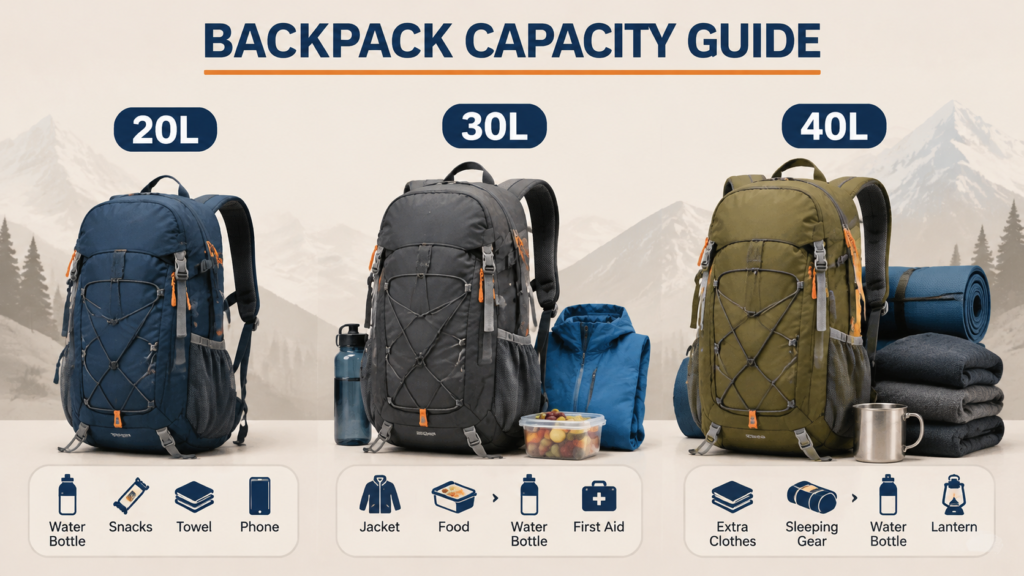
Backpack Capacity Guide
| Backpack Capacity | Typical Use | Common Items |
|---|---|---|
| 10–20L | Short walks and daily activities | Water bottle, snacks, personal essentials |
| 20–30L | Day trips and light hiking | Extra clothing, food, small accessories |
| 30–40L | Extended day trips and light overnight travel | Clothing, personal gear, additional supplies |
| 40–50L | Weekend outdoor adventures | Multiple clothing layers and camping essentials |
| 50L+ | Longer trips and equipment-heavy travel | Larger gear loads and extended-trip supplies |
These are general planning ranges rather than strict rules. Actual requirements depend on your equipment, packing style, and activity.
How to Calculate the Capacity You Need
Before purchasing, consider three questions:
1. How long will your trip last?
A short day hike generally requires less storage than a two-night camping trip.
2. What equipment will you carry?
A camera, extra clothing, food, and specialized outdoor equipment can quickly increase the space required.
3. Will you need additional protective storage?
Separate waterproof pouches, electronics cases, and dry bags may occupy additional space.
Example: Packing for a Weekend Outdoor Trip
A typical weekend packing arrangement might include:
| Item | Suggested Storage |
|---|---|
| Two or three clothing changes | Main compartment |
| Lightweight jacket | Main compartment |
| Food and snacks | Separate pouch |
| Water bottle | Side pocket |
| Phone and accessories | Small internal pocket |
| Personal essentials | Front or internal compartment |
Before choosing a backpack, check its stated capacity and actual dimensions.
A 30L backpack from one manufacturer may not have the same proportions or internal layout as a 30L backpack from another.
5. Comfort and Fit: What Matters for Outdoor Travel?
Even a technically advanced backpack can become uncomfortable if it does not fit properly.
For hiking and longer outdoor activities, carrying comfort should be one of your main considerations.
5.1 Adjustable Shoulder Straps
Shoulder straps should allow you to adjust the backpack to your body.
Look for:
- Adjustable strap length.
- Suitable padding.
- Smooth edges.
- Secure attachment points.
The backpack should remain stable without creating excessive pressure around the shoulders.
5.2 Back Panel Design
The back panel affects how the backpack sits against your body.
Some outdoor backpacks feature padded or ventilated back panels designed to improve comfort.
Mesh materials and ventilation channels may help reduce direct contact in certain designs.
However, ventilation performance depends on the complete structure and how the backpack is worn.
5.3 Weight Distribution
A properly organized backpack can help distribute weight more comfortably.
As a general guideline:
- Place heavier items closer to your back.
- Keep frequently used items accessible.
- Avoid placing heavy objects loosely at the top.
- Adjust the shoulder straps after loading.
5.4 Empty Backpack Weight
Do not overlook the backpack’s own weight.
A large backpack with additional hardware and multiple compartments may weigh more than a simpler design.
Compare the empty weight before purchasing, especially if you plan to walk for extended periods.
6. Best Backpack Features for Different Outdoor Activities
Not every outdoor activity requires the same backpack.
The best design depends on your environment and the belongings you need to carry.
6.1 Hiking and Day Trips
For hiking, prioritize:
- Comfortable shoulder straps.
- Suitable storage capacity.
- Water bottle access.
- Lightweight construction.
- Appropriate moisture protection.
A practical daypack should accommodate essential belongings without becoming unnecessarily bulky.
6.2 Camping and Weekend Travel
Camping requires more equipment and clothing.
Consider:
- Larger storage capacity.
- Multiple compartments.
- Reinforced construction.
- Suitable weight distribution.
- Space for separate protective pouches.
If your trip involves prolonged rain, consider a specialized waterproof backpack or an additional waterproof liner.
6.3 Urban Outdoor Travel
Outdoor travel does not always mean hiking through mountains.
City exploration, walking tours, and day trips also require practical storage.
A suitable backpack may include:
- A clean and versatile appearance.
- Convenient front and side pockets.
- A suitable laptop or tablet compartment.
- Adjustable shoulder straps.
- Water-resistant exterior materials.
6.4 Cycling and Commuting
For cycling and daily commuting, consider a backpack that stays stable during movement.
Useful features may include:
- Adjustable straps.
- Secure closures.
- Reflective details where provided.
- Practical access to essential belongings.
- Suitable protection for electronics.
Choosing a Backpack by Activity
| Activity | Recommended Priorities |
|---|---|
| Day hiking | Comfort, lightweight design, suitable capacity |
| Camping | Larger storage, durability, practical organization |
| Urban travel | Versatility, easy access, everyday styling |
| Cycling | Stability, secure storage, visibility features |
| Rainy-weather commuting | Water-resistant construction and electronics protection |
7. How to Protect Your Belongings During Heavy Rain
Even if you purchase a water-resistant backpack, additional precautions can help protect sensitive belongings.
Use Waterproof Pouches for Electronics
Phones, cameras, tablets, and other electronic devices are particularly sensitive to moisture.
A separate waterproof pouch can provide additional protection.
Do not rely solely on the backpack’s outer fabric when carrying valuable electronics in heavy rain.
Use a Backpack Rain Cover
A compatible rain cover can provide an additional protective layer.
Rain covers are especially useful when:
- Walking in prolonged rain.
- Hiking through wet vegetation.
- Traveling in unpredictable weather.
- Carrying a backpack with exposed external pockets.
Make sure the cover fits the backpack correctly.
Separate Wet and Dry Belongings
A useful packing method is to separate clothing and equipment into different pouches.
For example:
- Clean clothing in one dry pouch.
- Wet clothing in a separate waterproof bag.
- Electronics in protective cases.
- Food and personal essentials in dedicated compartments.
This makes it easier to keep important belongings organized.
8. Common Mistakes When Buying a Waterproof Backpack
Many shoppers focus on appearance and price but overlook important construction details.
Here are some common mistakes to avoid.
Mistake 1: Assuming Water-Resistant Means Waterproof
A water-resistant fabric may handle light rain but may not protect against prolonged exposure or immersion.
Always check the manufacturer’s actual specifications.
Mistake 2: Choosing Capacity Without Considering Your Equipment
A large backpack is not necessarily better.
Think about what you will carry and how much space you genuinely need.
Mistake 3: Ignoring Zippers and Seams
Even when the main fabric offers moisture protection, exposed openings may allow water to enter.
Check the entire construction.
Mistake 4: Buying Based Only on Appearance
A backpack may look suitable for outdoor activities but lack the necessary storage, comfort, or protection features.
Review the specifications before purchasing.
Mistake 5: Forgetting About Weight and Fit
A heavy or poorly fitted backpack can become uncomfortable during longer trips.
Always compare the empty weight, dimensions, and adjustment features.
9. Waterproof Backpack Buying Checklist
Before purchasing your next outdoor backpack, use this checklist to compare different models.
| Buying Consideration | What to Check |
|---|---|
| Material | Nylon, polyester, or specialized coated fabric |
| Water protection | Clearly stated product specifications |
| Zippers | Water-resistant design or protective covers |
| Seams | Standard stitching, taped seams, or welded construction |
| Capacity | Suitable for your trip duration |
| Dimensions | Appropriate size for your body and equipment |
| Comfort | Adjustable straps and suitable back panel |
| Weight | Manageable empty weight |
| Storage | Practical compartments and pockets |
| Maintenance | Clear cleaning and care instructions |
The right backpack should balance protection, comfort, capacity, and everyday practicality.
10. Frequently Asked Questions
Are waterproof backpacks completely waterproof?
Not necessarily. Waterproof performance depends on the material, seam construction, closures, and tested protection level.
Some backpacks are designed for heavy rain, while others are only suitable for light moisture exposure.
Is a water-resistant backpack good enough for hiking?
For many day hikes and ordinary outdoor activities, a water-resistant backpack may be sufficient.
However, if you expect prolonged heavy rain or significant water exposure, consider a specialized waterproof design or use an additional protective liner.
What is the best material for a waterproof backpack?
There is no single best material for every situation.
Nylon and polyester are common backpack materials, while TPU-coated and PVC-coated fabrics are used in certain specialized waterproof products.
The complete construction matters more than the material name alone.
What size backpack is best for a day hike?
A 20–30L backpack is a common starting point for many day hikes.
The right capacity depends on the length of the activity, weather conditions, and equipment you need.
Do I still need a rain cover for a waterproof backpack?
It depends on the backpack’s construction and intended use.
A compatible rain cover can provide an additional layer of protection, particularly during prolonged exposure to rain.
How do I clean a waterproof backpack?
Follow the manufacturer’s care instructions.
Generally, gentle surface cleaning with a soft cloth and suitable mild cleaning solution is preferable to harsh chemicals or aggressive machine washing.
Allow the backpack to dry completely before storage.
Can I use a waterproof backpack for everyday commuting?
Yes. Many outdoor backpacks can also be used for commuting, travel, and everyday activities.
Consider whether the design offers suitable storage for your laptop, personal belongings, and daily essentials.
Final Thoughts: Choose a Backpack That Matches Your Journey
Choosing the right waterproof backpack is about understanding how you plan to use it.
A suitable design should provide the appropriate level of moisture protection, enough storage for your equipment, comfortable carrying features, and practical organization.
For everyday commuting and occasional outdoor activities, a water-resistant backpack may be a sensible choice. For extended exposure to heavy rain or water-based activities, specialized waterproof construction is worth considering.
Take the time to compare fabric specifications, closures, seams, capacity, and comfort before making your decision.
At SUN EIGHT, we believe a good bag should support the way you travel, work, and explore.
Explore the SUN EIGHT Backpack Collection and discover functional carrying options for everyday adventures and journeys ahead.

One comment
A WordPress Commenter
Hi, this is a comment.
To get started with moderating, editing, and deleting comments, please visit the Comments screen in the dashboard.
Commenter avatars come from Gravatar.